Organ-preserving treatment for rectal cancer draws international interest
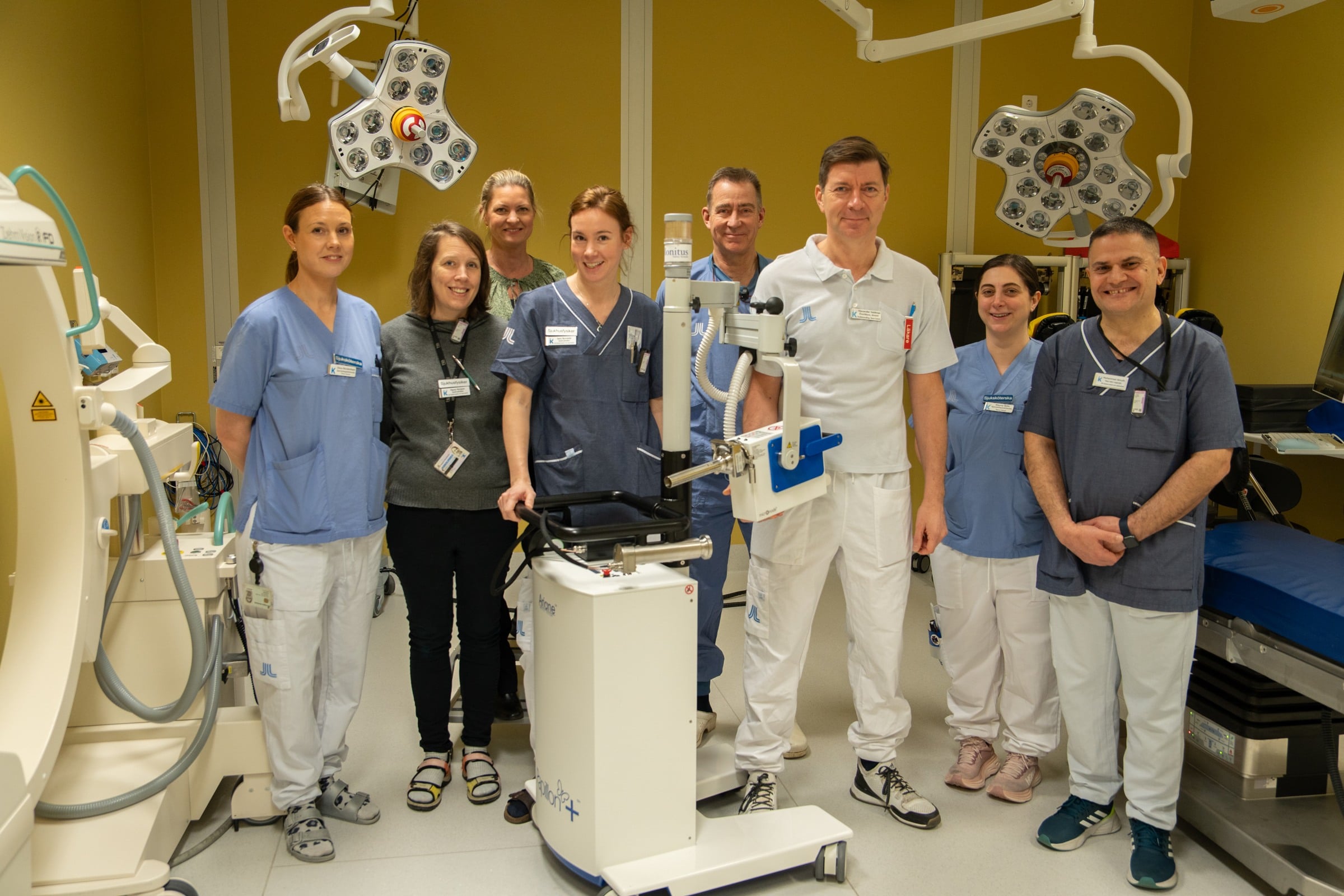
Since the contact therapy method was introduced in March 2025, Karolinska University Hospital has developed into a national and international center for the treatment of rectal cancer. Patients from across Sweden, and from other countries as well, are seeking out the hospital to access this highly specialized care.
The treatment is offered as part of two clinical studies, CORRECT and BRARECT, in which 38 and 8 patients, respectively, have been enrolled so far. An additional 14 patients have been treated outside the studies. In total, 60 patients have received contact therapy at Karolinska, around half of whom come from other regions in Sweden.
“We have also received two patients from San Francisco in the United States, where the method is not yet in use,” says Alexander Valdman, senior consultant at the Unit for Radiotherapy.
Avoiding major surgery
Contact therapy is an organ-preserving treatment that aims to avoid extensive surgery in which the entire rectum is removed. The international OPERA trial (1), on which the Swedish national study CORRECT (2) builds, shows that 93 percent of patients with early-stage rectal cancer can avoid such surgery after five years of follow-up.
“The results create conditions for a better quality of life and a reduced risk of complications that can follow extensive surgical procedures,” says Alexander Valdman.
The method is relevant for patients with early and early-intermediate rectal cancer who want to avoid extensive surgery. It can also be an option for patients who have undergone local excision, in which only the tumor and a small portion of the surrounding tissue is removed, but where risk factors warrant further treatment.
“The proportion of patients diagnosed with early-stage rectal cancer is increasing and today accounts for roughly 25 percent of all newly detected cases. An important explanation is the introduction of screening in Sweden, where certain population groups are offered the opportunity to submit a stool sample to detect cancer at an early stage,” says Alexander Valdman.
What comes next
The next step is to complete the ongoing clinical studies, compile the results, and follow the patients over a longer period. The follow-up will provide a clearer picture of how many patients can avoid extensive surgery in the long term, how the treatment affects function and quality of life, and what significance the results may have for future treatment strategies in rectal cancer.
References:
- OPERA trial
Baron et al. A phase III randomised trial on the addition of a contact X-ray brachytherapy boost to standard neoadjuvant chemo-radiotherapy for organ preservation in early rectal adenocarcinoma: 5 year results of the OPERA trial.
Ann Oncol. 2025 Feb;36(2):208-215 https://pubmed.ncbi.nlm.nih.gov/39532203/ - CORRECT trial
Nilsson et al. Contact radiotherapy for rectal cancer (CORRECT): study protocol for a multicentre randomised phase II trial
BMJ Open 2025, Apr 9;15(4):e100356 https://pubmed.ncbi.nlm.nih.gov/40204311/